|
|
|
|
Budget 2025: What does it mean for low income households?
After weeks of leaks, Budget 2025 contained few surprises, aside from the OBR accidentally publishing its report 40 minutes before the Chancellor took to the despatch box. The Government’s headline announcement was the lifting of the two-child limit, accompanied by a series of tax adjustments largely benefitting households with higher earnings.
Our analysis of the removal of the two-child limit, and its interaction with the benefit cap, was picked up by the Financial Times, DWP and others. Local authorities have told us they value being able to identify both the families who stand to gain from the change, and the one in ten who do not.
Our Head of Policy, Rebecca McDonald has prepared a set of takeaways from the Budget for low income households.
Read more in our blog
Deven Ghelani was on LBC ahead of the Budget outlining the damage the 2 child limit had done to children's prospects and why it should be abolished. He also recorded an explainer video for Nick Ferrari which you can listen to here.
|
|
|
|
|
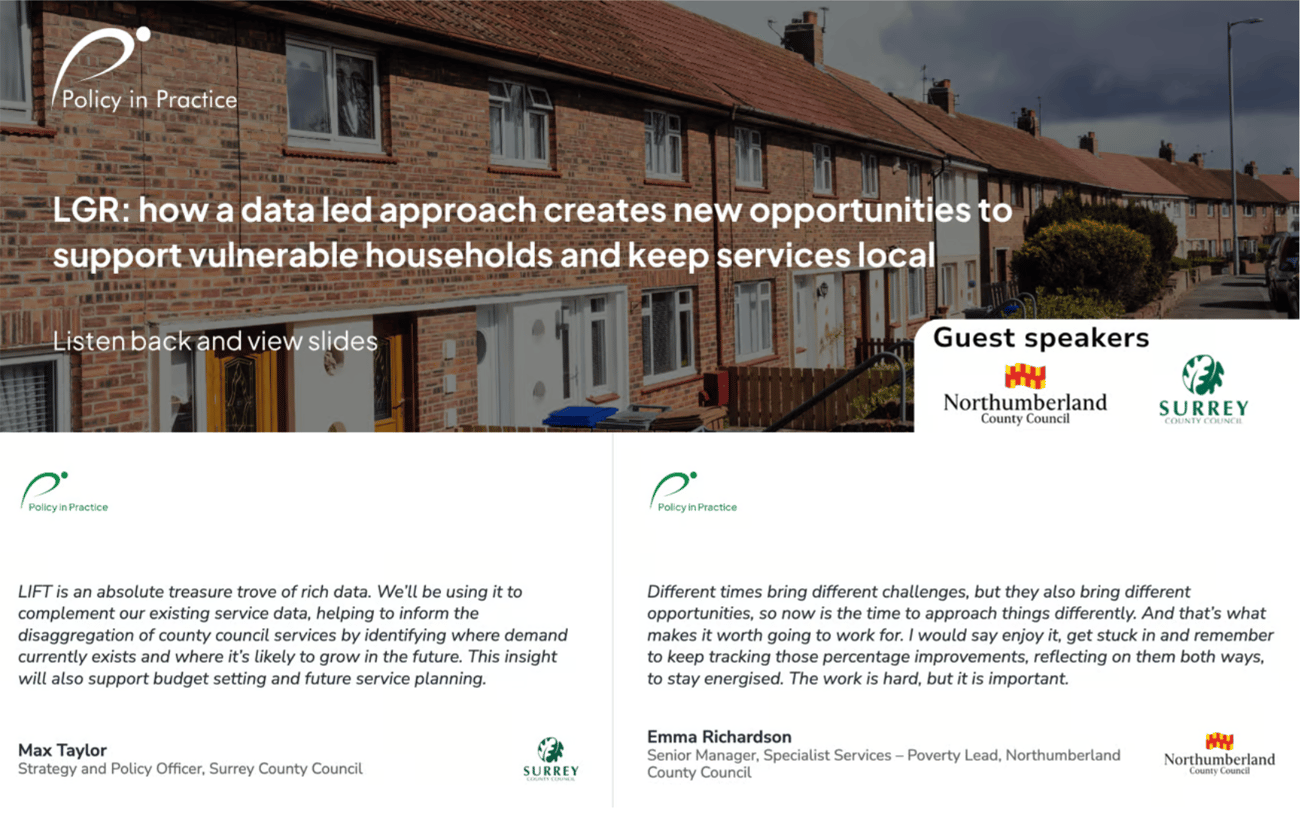
Learnings from Surrey and Northumberland County Councils on LGR
Local government reorganisation (LGR) promises leaner, more integrated governance, but with change there is always uncertainty. How can councils maintain the proximity, agility and empathy that residents depend on, while managing large scale change, and larger often geographical remits?
Our recent webinar explored that question through the experiences of Surrey County Council and Northumberland County Council, two authorities at different points in their reorganisation journeys but united by a data led, community focused approach.
|
|
|
|
|
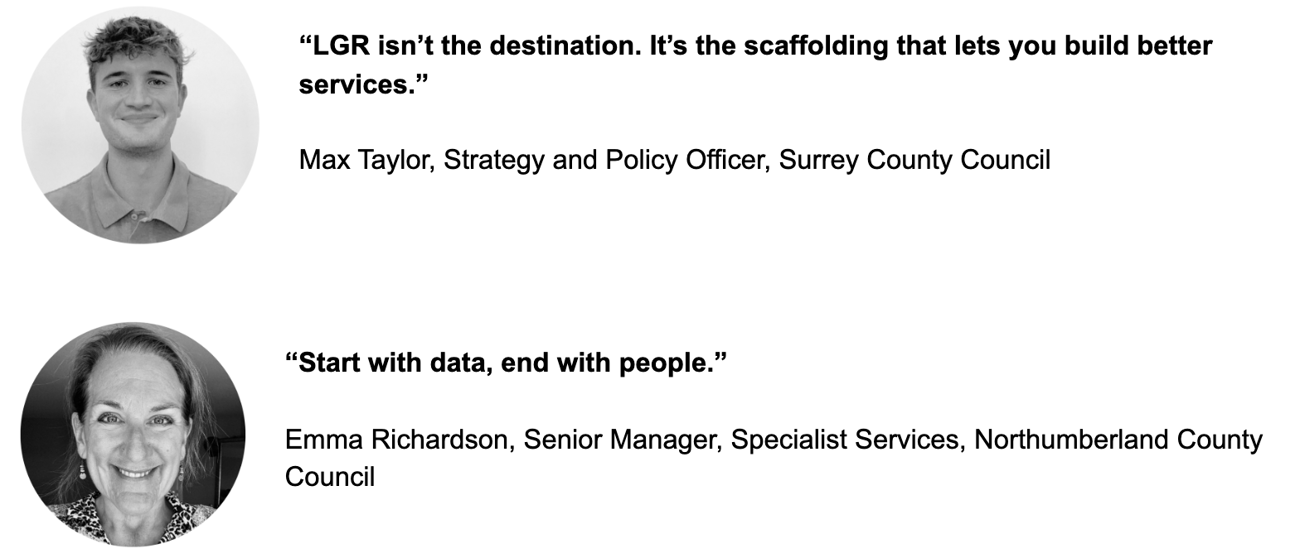
Both councils are using data not simply to measure change, but to lead it, ensuring that as structures evolve, the connection with residents becomes stronger, not weaker.
For the full discussion, audience Q&A and slides, view the webinar here
|
|
|
|
|
New report with Trussell on Crisis and Resilience Fund to be launched on 2 December
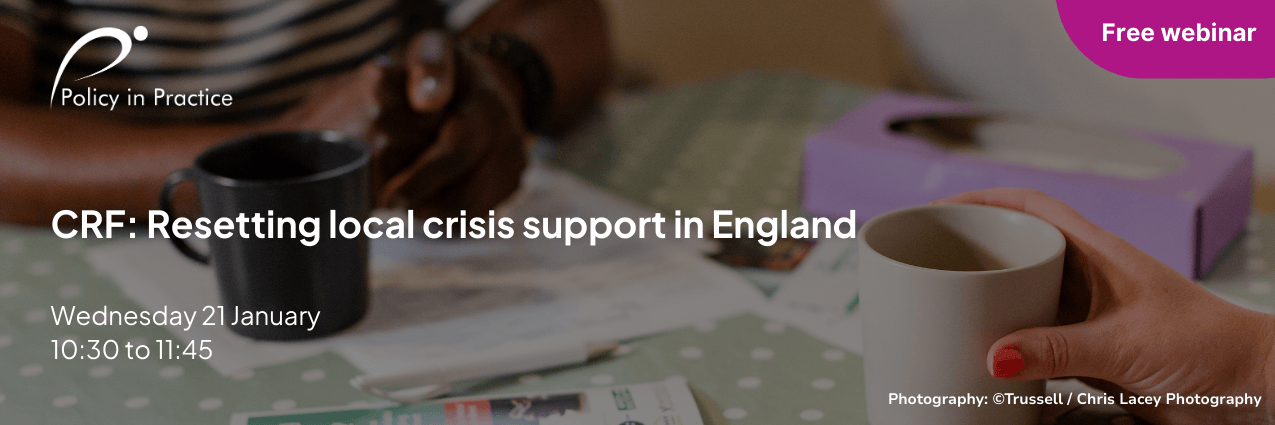
Policy in Practice and Trussell have written a joint report: 'Resetting local crisis support in England' to inform the delivery of the new Crisis and Resilience Fund (CRF). The report's analysis and recommendations cover provision and access to effective crisis support, how you can improve the financial resilience of individuals and local communities and bolster community level support.
Register for our webinar with Trussell on 21 January 2026, and request an early copy of the report (due to be published on 2 December) to learn more about our recommendations and explore practical examples focused on:
- Delivering a cash-first approach to local crisis support
- Using the CRF to build financial resilience for people most at risk of financial crisis
- Developing a systematic approach to monitoring and evaluating outcomes
|
|
|
|
|
Policy in Practice and DebtStream integrate income maximisation into the digital repayment journey
Policy in Practice and DebtStream have created a one stop collections portal that brings income maximisation into the heart of the digital repayment journey. By embedding the GOV.UK recommended Better Off Calculator directly within DebtStream’s self serve flows, customers discover unclaimed support without leaving the portal.
This integrated approach closes the awareness gap that causes many eligible households to miss out on benefits, often worth hundreds of pounds a month. With greater income and clearer guidance, customers can set up affordable, sustainable plans, improving financial wellbeing and reducing repeat arrears.
For creditors, the result is higher engagement, more resilient arrangements and stronger evidence demonstrating compliance with the FCA Consumer Duty. It also enhances brand trust by demonstrating a supportive, outcomes focused approach.
One year on from the initial announcement, live deployments show how combining collections innovation with income maximisation delivers results that are greater than the sum of their parts, fairer for customers and commercially smarter for organisations.
Learn how our one-stop portal supports fairer collections and better outcomes
|
|
|
|
|
Bridging the gap: policy trends and innovations in employment support
2.8 million working age people are now out of work due to ill health and the number is still rising. Just published, the Mayfield Keep Britain Working report for the Department for Work and Pensions (DWP) shines a much needed spotlight on this challenge, but employers are still left with big questions about what to do next.
Earlier this month, Deven Ghelani, joined Andrew Marr on LBC Radio to discuss the rise in people on Universal Credit with no expectation to look for work. As Deven sets out, much of this rise is to be expected.
Changes such as the managed migration from Employment and Support Allowance (ESA) to Universal Credit (UC) and the increase in the state pension age have resulted in more people qualifying for the health element of UC. Overall caseloads have still not reached the 7.2 million households forecast before managed migration began.
Watch the interview here
|
|
|
|
|
Against this backdrop, it was especially timely to attend the ERSA Conference and Employability Awards this month. The event highlighted the vital role that employment programmes and local authorities play in helping people overcome barriers to work. It is exactly the kind of support needed as ill health and economic inactivity rise, which will require both system-wide action and the continued innovation of those delivering employment support on the ground.
We were delighted to see recognition for leaders and trailblazers in the sector. As Deven said,
“Congratulations to Richard Clifton on his win in the ‘Outstanding Contribution’ category for his work with Shaw Trust and others over the last 30 years. Richard has been at the forefront of several groundbreaking employability programmes, including Connect to Work.”
|
|
|
Get ready for our 12 Days of Christmas: celebrating your impact in 2025
This December, we’re excited to share our annual 12 Days of Christmas campaign, showcasing the brilliant work our clients have delivered throughout 2025. Across many sectors, teams have worked tirelessly to boost incomes, reduce arrears, prevent hardship and change lives for the better.
Each day, we’ll reveal a new story highlighting the real difference data driven support can make, from councils increasing benefit take up, to housing teams preventing homelessness, to utility and finance providers helping customers stay afloat during the cost of living crisis.
The stories featured this year are powerful, practical and full of hope. They demonstrate the creativity, compassion and commitment you bring to supporting households in challenging times.
We hope these stories inspire you as much as they’ve inspired us. Keep an eye on your inbox, the first story lands on Monday 1 December.
|
|
|
|
|
|
|
|
Welcoming Children North East as the first visitors to our new office
Earlier this month we welcomed our first external visitors to our new office: Suzanne Jobson and Lorna Nicoll from Children North East, who met with Deven Ghelani, Rebecca McDonald and Tylor Maria Johnson to talk about supporting families across the region.
Children North East’s work is both impactful and deeply aligned with our own, particularly their poverty proofing programme, which tackles stigma and helps schools remove barriers faced by children growing up on a low income.
We look forward to welcoming you too. Contact us to pay a visit to our new home.
|
|
|
|
|
|
|
|
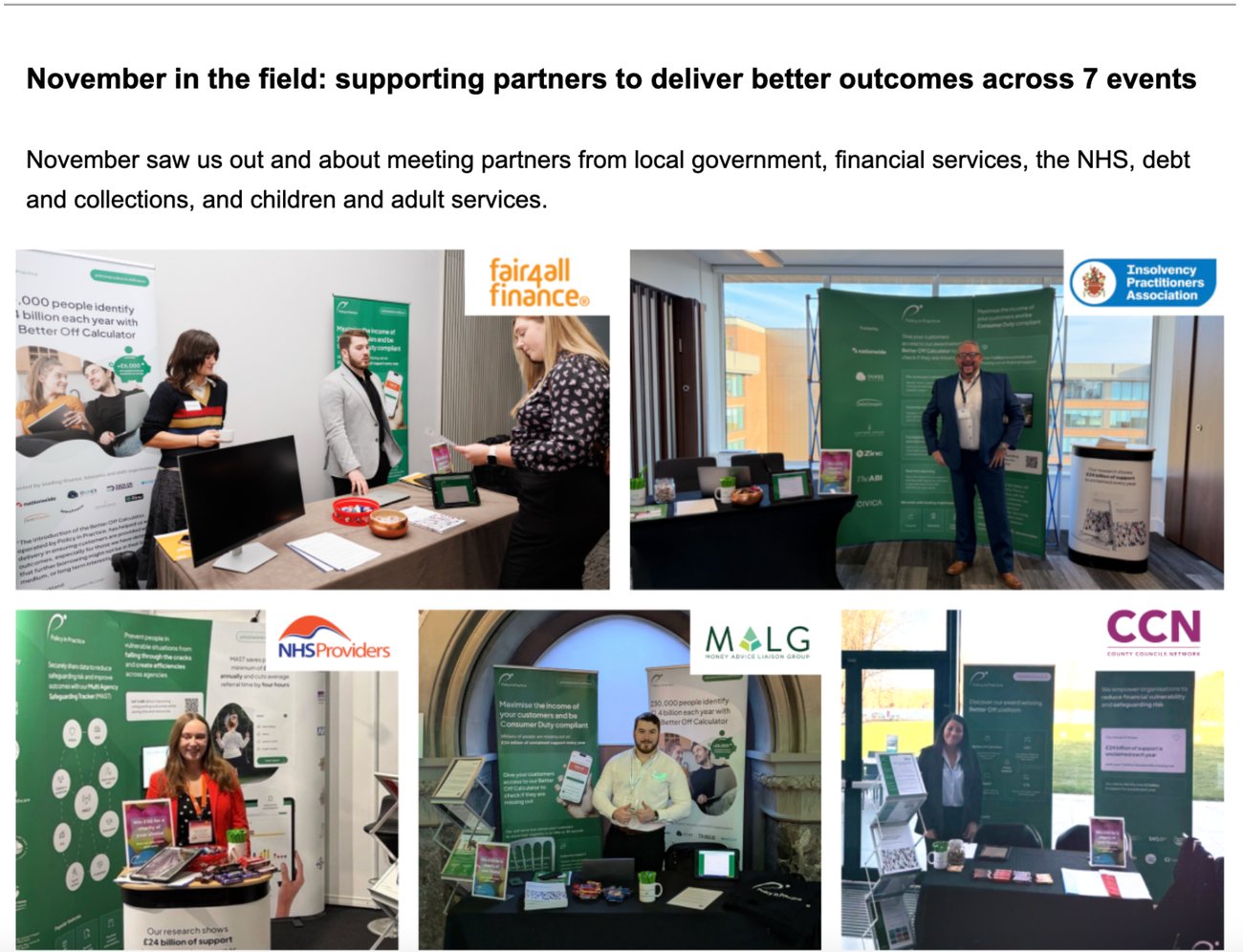
1. At the Fair4All Finance Conference, Xanthe Fairhead and Ed McNamara shared how collaborations such as our partnership with Nationwide simplify benefit applications, helping people claim the support they are due while improving engagement, completion rates and Consumer Duty compliance.
2. At the Personal Insolvency Conference, Rob Johnson and Deven Ghelani discussed tracking income, converting near misses into paying clients and embedding proactive benefits checks. Deven also gave a talk on helping people move out of debt at the conference.
3. At NHS Providers, Jennifer Downie, Sam Fathers and Adam Kenny showcased how MAST speeds up referrals and highlights vulnerability earlier, enabling more preventative safeguarding and better use of community resources.
4. At the MALG Conference, Ed McNamara and Peter Snell spoke about how our Better Off Calculator is helping organisations maximise income for customers by making benefit applications simpler, improving financial resilience for households and achieving better outcomes for their own organisations.
5. At the County Council Network, Sam Fathers and Amy Bassi explored how councils can use tools like LIFT to get ahead of local government reorganisation. By preparing early and making the most of their data, councils can turn uncertainty into opportunity and ensure services stay effective and local.
|
|
|
|
|
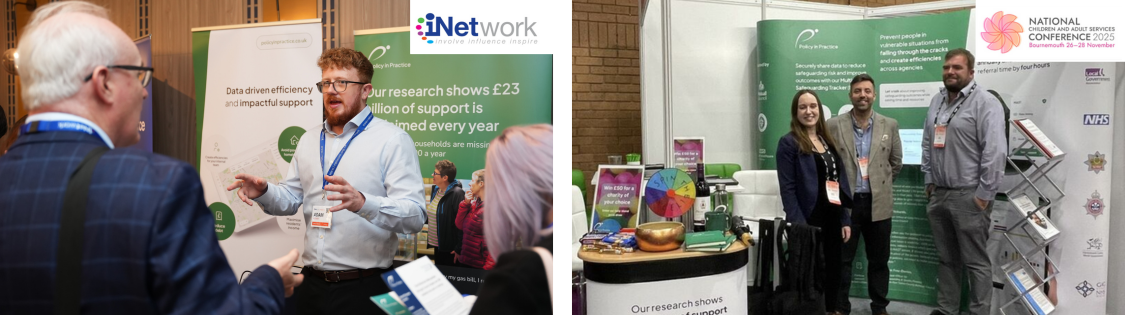
6. At the iNetwork Conference, our Head of Business Development for the North, Adam Kenny, explored how intelligent analytics can help local authorities connect their data, help maximise their residents’ financial resilience and reduce their costs.
7. And finally, Jennifer Downie, Sam Fathers and Paul Garlick were at the National Children and Adult Services Conference (NCASC). There was a clear recognition that siloed data is holding the system back and that tools like MAST can help create a more coherent and responsive approach.
From financial services to social care, our conversations this month showed that whether the challenge is maximising income or improving safeguarding, data led solutions are helping our partners deliver more timely, targeted support.
Missed us in November? Book a call with our team to discuss your priorities and how we can help
|
|
|
|
|
November webinars to view on demand
|
|
|
|
|
|
|
|
|
|
|
|
|
Stay informed: join our upcoming free webinars
|
|
|
|
|
|
|
Review of 2025 in policy and practice: From data to impact
Wednesday 10 December from 10.30 to 11.45. See details and register
|
|
|
|
|
|
|
|
|
|
|
|
|
Budget 2025: What does it mean for low income households?
By Rebecca McDonald
After weeks of leaks, Budget 2025 contained no surprises. As ever, the complexity of the welfare system means working out the true impact of the Budget isn’t straightforward. In this blog we set out the main takeaways we think you need to know. Read blog
|
|
|
|
|
|
|
|
New analysis: Benefit cap blocks support for 1 in 5 families hit by two child limit
By Rory Ewan
New analysis finds that 1 in 10 children hit by the two child limit won't benefit from its removal unless the Chancellor lifts the Benefit Cap too. Read blog
|
|
|
|
|
|
|
|
Keep Britain Working: What the new Mayfield report misses for employers
By Rich Jones
Sir Charlie Mayfield’s Keep Britain Working review highlights key labour challenges but employers need clearer actions to drive real change. Read blog
|
|
|
|
|
|
|
|
Come and work with us at Policy in Practice
Open roles:
- Senior Policy and Data Analyst
- Business and Account Manager
- Client Services Manager
|
|
|
|
|
|
|
|
|